
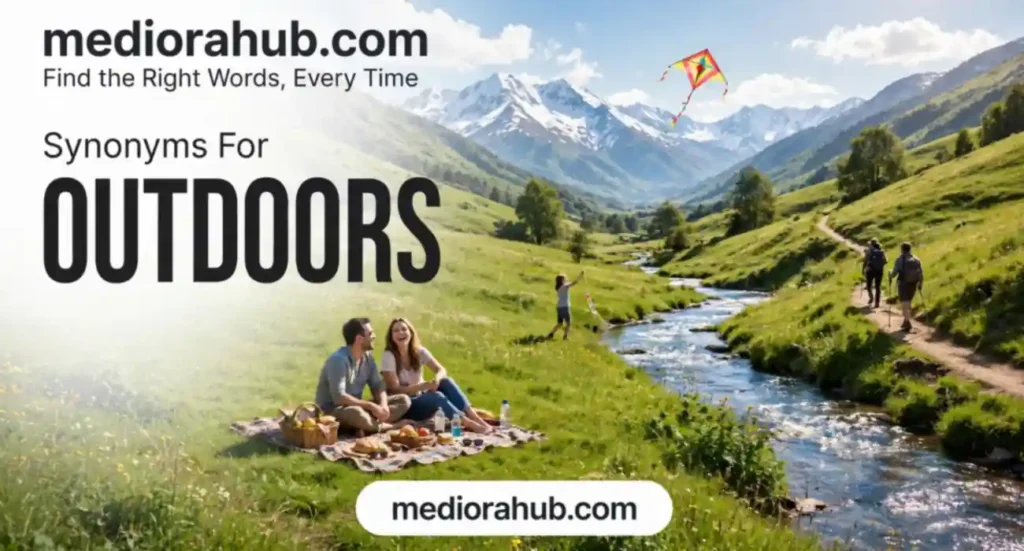

After a long week inside four walls, nothing feels better than stepping out into the sunshine. Think of a family spreading a picnic blanket under a big tree, children running across the grass, and a cool breeze moving through the leaves. That whole world beyond your front door is the outdoors: the open air, the parks, the hills and the sky above you. People love this open world because it makes them feel free, calm and full of energy. English gives us many warm and lively words for this open world, from simple “outside” to the grand “the great outdoors”. In this article, you will learn 25 synonyms for outdoors with simple meanings and clear examples, plus the full word details, an honest comparison with outside and nature, and answers to the questions learners ask most.
Quick Answer
| Question | Answer |
|---|---|
| What does outdoors mean? | The world outside buildings: open air, land, parks and nature beyond your walls. |
| What part of speech is outdoors? | Noun and adverb (the related adjective is “outdoor”). |
| What are the best synonyms for outdoors? | Outside, open air and the great outdoors are the closest everyday words. |
| What is the opposite of outdoors? | Indoors |
| How do you use outdoors in a sentence? | The children played outdoors until the sun went down. |
Outdoors Complete Word Details
Meaning
Outdoors is a noun that means the open world outside any building: the fresh air, the land, the trees, the rivers and the sky. As an adverb, it tells you where something happens, as in “We ate outdoors.” It is the place where people walk, play, camp, garden and enjoy nature, away from rooms and roofs.
Parts of Speech
Outdoors works as a noun and as an adverb. As a noun: “She loves the outdoors.” As an adverb: “They slept outdoors under the stars.” The close adjective form is “outdoor” (without the final s), used before a noun: “an outdoor market”, “outdoor games”.
Etymology
Outdoors grew out of the older phrase “out of doors”, which people used for anything beyond the door of the house. English speakers have used this phrase since the 1700s to mean the open air outside the home, and over time the shorter single word “outdoors” became the common form we use today.
Syllables and Pronunciation
Outdoors has 2 syllables: out-doors. It is pronounced /ˌaʊtˈdɔːrz/, with the stronger beat on the second part: out-DOORS.
Connotation
Outdoors has a fresh, healthy and happy connotation. It brings feelings of freedom, adventure, clean air and honest fun. People link the word with strong bodies, clear minds and simple pleasures, so it almost always sounds positive in everyday English.
Collocations
Outdoors is often used with these words and phrases: the great outdoors, love the outdoors, enjoy the outdoors, spend time outdoors, play outdoors, eat outdoors, sleep outdoors, work outdoors, outdoor activities, outdoor life.
Do Not Confuse
- Outdoors vs Outside: Outside is the wider, plainer word for any place that is not inside, even the pavement right outside a shop. Outdoors feels bigger and greener: it suggests open air, land and nature, not just the other side of a wall.
- Outdoors vs Open Air: Open air names the fresh air itself and the open space above and around you. Outdoors names the whole outdoor world and the life you live in it, so “a love of the outdoors” sounds wider than “a love of the open air”.
Idioms and Common Phrases
- The great outdoors: a warm, slightly grand name for nature and the outdoor world, often used by people who love camping and hiking.
- Outdoor type: a person who loves spending time outside and enjoys active, open air pursuits.
- Out in the elements: outside in the weather, facing wind, rain or cold without shelter.
- A breath of fresh air: a short time outside in clean air, or a welcome new change.
- Outdoor pursuits: activities done outside, such as hiking, climbing, fishing and camping.
Quick Facts
| Fact | Detail |
|---|---|
| Word | Outdoors |
| Parts of speech | Noun and adverb |
| Syllables | 2 |
| Pronunciation | /ˌaʊtˈdɔːrz/ |
| Origin | From the phrase “out of doors” |
| First common use | The 1700s |
| Opposite | Indoors |
| Synonyms in this article | 25 |
25 Best Synonyms for Outdoors
1. Outside
Outside is the simplest word for any place that is not inside a building, room or enclosed space.
- The children waited outside while their mother locked the door.
- It is much colder outside than in the warm kitchen.
2. Open Air
Open air means the fresh air and open space outside buildings, under the sky.
- We ate our lunch in the open air beside the river.
- Farmers work in the open air in every season.
3. The Great Outdoors
The great outdoors is a warm and grand phrase for nature and the whole outdoor world, loved by campers and hikers.
- Every summer, they leave the city to enjoy the great outdoors.
- His book is a love letter to the great outdoors.
4. Nature
Nature means the living world of plants, animals, land and water that exists without being made by people.
- A walk in nature clears her mind after a busy week.
- He takes photographs of nature in every country he visits.
5. Wilderness
Wilderness means wild land where people do not live and nature is left completely alone.
- They hiked for three days through the wilderness of Alaska.
- The wilderness is home to bears, wolves and eagles.
6. Countryside
Countryside means the land outside towns and cities, with fields, farms, villages and gentle hills.
- She grew up in the countryside and learned to ride a horse.
- We drove through green countryside all afternoon.
7. Out-of-Doors
Out-of-doors is the older full form of outdoors, still used in books to mean the open air beyond the house.
- In fine weather, the family took their tea out-of-doors.
- He wrote that no room could match the beauty of out-of-doors in spring.
8. Fresh Air
Fresh air means clean, cool air outside, and people often use it to stand for a short, healthy time outdoors.
- Open the windows and let in some fresh air.
- After hours at his desk, he went out for some fresh air.
9. The Wilds
The wilds are remote, rough areas far from towns, where few people live and nature rules.
- The explorers crossed the wilds of northern Canada.
- He lives alone in the wilds, miles from the nearest road.
10. Backcountry
Backcountry means the quiet, far away parts of the countryside or mountains, away from roads and crowds.
- They carried tents into the backcountry for the weekend.
- Backcountry trails are peaceful but need careful planning.
11. Open Country
Open country means wide land with long views, few buildings and plenty of space in every direction.
- The horses ran freely across the open country.
- She loves the feeling of space in open country.
12. Natural World
Natural world is a clear, slightly formal name for everything in nature: animals, plants, land, seas and weather.
- The film shows the wonders of the natural world.
- Children learn about the natural world on the school trip.
13. Exterior
Exterior means the outside part of a building or object, the side that faces the open air.
- The exterior of the old house needs fresh paint.
- Bright flowers decorate the exterior of the café.
14. Alfresco
Alfresco describes eating or relaxing outdoors, and it brings a happy, holiday feeling to meals in the open air.
- We enjoyed an alfresco lunch on the sunny terrace.
- The restaurant offers alfresco dining all summer.
15. Outdoor Life
Outdoor life means a way of living that includes plenty of time outside, in activities like walking, camping and gardening.
- He chose outdoor life over a desk job in the city.
- Outdoor life keeps the whole family fit and cheerful.
16. The Bush
The bush is a common word in Australia and Africa for wild countryside with trees and rough land away from towns.
- They camped in the bush and listened to the night sounds.
- A guide led us safely through the bush.
17. Backwoods
Backwoods are forest areas far from towns, and the word can also describe places that feel simple and far from modern life.
- Their small cabin stands deep in the backwoods.
- He grew up in the backwoods and knows every forest path.
18. Open Spaces
Open spaces are wide, clear areas of land without buildings, such as parks, fields and village greens.
- The city protects its open spaces for everyone to enjoy.
- Children need open spaces where they can run and play.
19. Under the Open Sky
Under the open sky is a gentle phrase for being outside with nothing above you but the sky itself.
- They slept under the open sky and counted the stars.
- A wedding under the open sky felt simple and beautiful.
20. Beyond the Walls
Beyond the walls is a fresh way of talking about everything that waits for you outside your home or office.
- Beyond the walls of the classroom, a whole garden was blooming.
- She found peace beyond the walls of her busy house.
21. Mother Nature
Mother Nature is a kind, human way of speaking about nature as if she were a mother who cares for the living world.
- Mother Nature paints the hills gold every autumn.
- After the long drought, Mother Nature finally sent the rain.
22. The Elements
The elements are the weather forces you meet outdoors, such as wind, rain, sun and cold.
- The old lighthouse stands firm against the elements.
- Good boots protect walkers from the elements.
23. Green Spaces
Green spaces are areas of grass, trees and plants in or near towns, where people can rest and breathe freely.
- The new park adds green spaces to a crowded district.
- Green spaces make hot cities cooler and calmer.
24. Country Air
Country air means the clean, fresh air of the countryside, often praised as good for health.
- The doctor told him that country air would help him rest.
- She opened the cottage window and breathed in the sweet country air.
25. Wild Nature
Wild nature means nature in its free, untouched state, full of life and not controlled by people.
- The island is a safe home for wild nature.
- Photographers travel far to see wild nature at its best.
Outdoors vs Outside vs Nature
These three words are close friends, but each one paints a slightly different picture. Outdoors is the whole open world beyond your walls, and the happy life you live there: walking, playing, camping and breathing freely. Outside is the plainest and widest of the three; it simply means “not inside”, and it can describe the pavement outside a shop or the step outside your door, with no feeling of nature at all. Nature is the living world itself: the trees, animals, rivers and mountains, whether you meet them in a wild forest or watch them in a film from your sofa.
| Word | What it points to | Feeling | Example |
|---|---|---|---|
| Outdoors | The open world beyond buildings, and life lived there | Fresh, free and active | The children played outdoors until the sun went down. |
| Outside | Any place that is not inside | Plain and simple | Please wait outside the office for a moment. |
| Nature | The living world of plants, animals and land | Wide and wonderful | A walk in nature helps her think clearly. |
In short, outside tells you where something is not, outdoors invites you into the open air, and nature names the living world you find when you get there.
Frequently Asked Questions
What is the meaning of outdoors?
Outdoors means the world outside buildings: the open air, the land, the parks and the countryside. As an adverb, it tells you where an action happens, as in “We slept outdoors.”
What is another word for outdoors?
The closest everyday words are outside, open air and the great outdoors. For wilder places, you can use wilderness, the wilds or backcountry, and for town parks and fields, open spaces or green spaces.
What is the difference between outdoors and outside?
Outside is the plainer word and means only “not inside”, even just beyond a door. Outdoors is warmer and wider: it suggests open air, land and nature, and the activities people enjoy there.
Is outdoors a noun or an adverb?
Outdoors is both a noun and an adverb. As a noun: “He loves the outdoors.” As an adverb: “They ate outdoors.” The adjective form is “outdoor”, as in “outdoor games”.
What is the opposite of outdoors?
The main opposite of outdoors is indoors. If outdoors is the open world beyond your walls, indoors is everything inside them, under a roof.
What does “the great outdoors” mean?
The great outdoors is a warm phrase for nature and the outdoor world as a whole. People use it when they talk about camping, hiking and enjoying wild, open places.
How do you use outdoors in a sentence?
You can say, “The children played outdoors until the sun went down.” Outdoors works as an adverb here. As a noun, you can say, “Nothing beats the outdoors on a clear spring morning.”
Conclusion
Outdoors is a bright and healthy word for the whole open world beyond our walls. Now you know 25 synonyms for outdoors, from plain outside and fresh open air to grand phrases like the great outdoors and wild places like the wilderness and backcountry, each with a simple meaning and real examples. Use outdoors for the general idea, and pick the closer word whenever you want to show the exact place, feeling or view. The right word at the right time makes your English clear, natural and strong.