
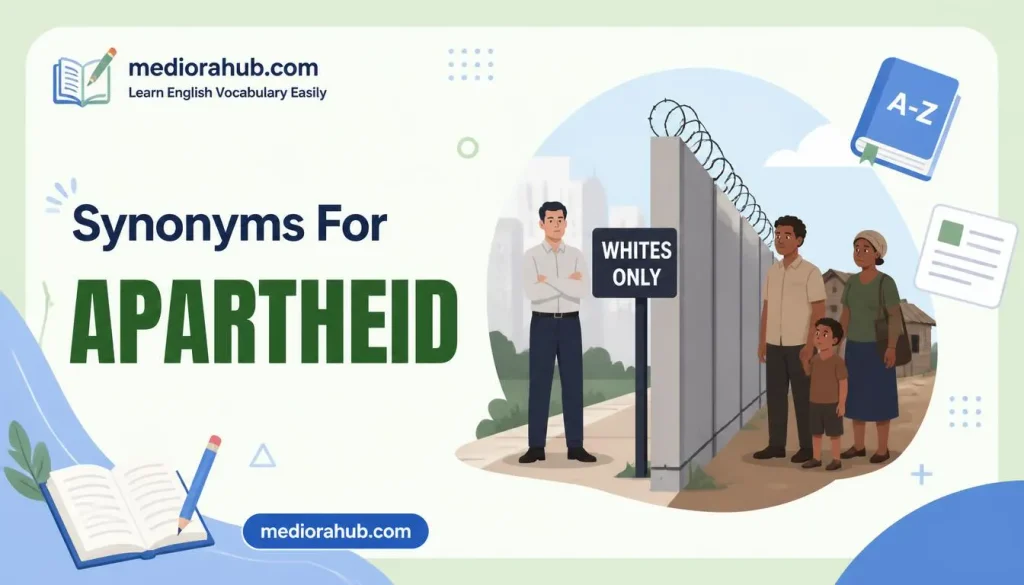

Imagine living in a place where people are treated differently because of their race. Some people can use certain schools, homes, or public places, while others cannot. This is an example of racial separation and discrimination. Apartheid means a system that separates people by race and gives them unequal rights. The word is best known for the system enforced by law in South Africa from 1948 until its end in the early 1990s. Learning synonyms for apartheid helps students understand history and write better essays. Bloggers and content writers can use related terms to explain social issues clearly. English learners can also build their vocabulary and improve their communication skills. In this guide, you will learn 25 related words and expressions, their simple meanings, and examples of how to use them.
Quick Answer: What Are Synonyms for Apartheid?
The closest alternatives and related terms for apartheid include racial segregation, racial discrimination, institutionalized racism, systemic racism, racial oppression, racial domination, racial exclusion, racial separation, racial hierarchy, racial injustice, legal segregation, enforced segregation, discriminatory rule, racial subjugation, racial persecution, white supremacy, racial inequality, ethnic segregation, social segregation, political exclusion, economic discrimination, state-sanctioned racism, racial marginalization, separate development, and Jim Crow segregation.
Important: These expressions are not all exact synonyms. Some describe the system of apartheid, while others refer to related forms of racism, discrimination, or segregation. Use the term that best fits the context.
Parts of Speech
| Word or Phrase | Part of Speech | Simple Meaning |
| Apartheid | Noun | A system of racial separation and unequal rights |
| Racial segregation | Noun phrase | Separating people by race |
| Racial discrimination | Noun phrase | Treating people unfairly because of race |
| Institutionalized racism | Noun phrase | Racism built into institutions or laws |
| Systemic racism | Noun phrase | Racism that operates through connected systems |
| Racial oppression | Noun phrase | Unfair control or harm based on race |
| Racial domination | Noun phrase | One racial group controlling another |
| Racial exclusion | Noun phrase | Keeping people out because of race |
| Racial separation | Noun phrase | Keeping racial groups apart |
| Racial hierarchy | Noun phrase | A system that ranks racial groups unequally |
| Racial injustice | Noun phrase | Unfair treatment based on race |
| Legal segregation | Noun phrase | Separation of groups required by law |
| Enforced segregation | Noun phrase | Separation that is imposed on people |
| Discriminatory rule | Noun phrase | A rule that treats certain people unfairly |
| Racial subjugation | Noun phrase | Keeping a racial group under another group’s control |
| Racial persecution | Noun phrase | Repeated cruel or unfair treatment based on race |
| White supremacy | Noun phrase | The belief that white people are superior to other racial groups |
| Racial inequality | Noun phrase | Unequal rights or opportunities based on race |
| Ethnic segregation | Noun phrase | Separating people based on ethnic background |
| Social segregation | Noun phrase | Keeping groups apart in social life |
| Political exclusion | Noun phrase | Preventing people from taking part in political life |
| Economic discrimination | Noun phrase | Unfair treatment in jobs, pay, or economic opportunities |
| State-sanctioned racism | Noun phrase | Racism approved or enforced by the state |
| Racial marginalization | Noun phrase | Pushing a racial group to the edges of society |
| Separate development | Noun phrase | A policy presented as allowing groups to develop separately; historically used to describe apartheid policies |
| Jim Crow segregation | Noun phrase | Racial separation enforced by laws and customs in parts of the United States |
1. Racial Segregation
Meaning: Racial segregation means keeping people apart because of their race.
Examples:
- Racial segregation kept many South Africans apart under apartheid.
- The history lesson explained how racial segregation affected schools.
2. Racial Discrimination
Meaning: Racial discrimination means treating someone unfairly because of their race.
Examples:
- Racial discrimination can deny people equal chances.
- The law was created to protect people from racial discrimination.
3. Institutionalized Racism
Meaning: Institutionalized racism means racism that is built into the rules or actions of an institution.
Examples:
- The report examined institutionalized racism in public services.
- Students learned how institutionalized racism can affect access to education.
4. Systemic Racism
Meaning: Systemic racism means unfair racial treatment that operates through the rules and practices of a wider system.
Examples:
- The researchers studied systemic racism in housing.
- The discussion explored ways to address systemic racism.
5. Racial Oppression
Meaning: Racial oppression means using power to control or harm people because of their race.
Examples:
- Many people resisted racial oppression during apartheid.
- The book describes the effects of racial oppression on families.
6. Racial Domination
Meaning: Racial domination means one racial group holds power over another.
Examples:
- Apartheid maintained racial domination through laws.
- The historian explained how racial domination shaped public life.
7. Racial Exclusion
Meaning: Racial exclusion means keeping people out of places or activities because of their race.
Examples:
- Racial exclusion prevented some people from using public facilities.
- The campaign called for an end to racial exclusion.
8. Racial Separation
Meaning: Racial separation means dividing people into different groups based on race.
Examples:
- Racial separation affected where people could live.
- The class discussed the harm caused by racial separation.
9. Racial Hierarchy
Meaning: Racial hierarchy means arranging racial groups in an unequal order of power or status.
Examples:
- The policy created a racial hierarchy in society.
- The documentary showed how racial hierarchy affected people’s rights.
10. Racial Injustice
Meaning: Racial injustice means unfair treatment of people because of their race.
Examples:
- The students wrote essays about racial injustice.
- Many activists worked to challenge racial injustice.
11. Legal Segregation
Meaning: Legal segregation means separating groups through laws.
Examples:
- Legal segregation shaped daily life under apartheid.
- The history teacher explained the effects of legal segregation.
12. Enforced Segregation
Meaning: Enforced segregation means forcing people to live, study, or gather separately.
Examples:
- Enforced segregation limited where people could travel.
- The museum displayed records of enforced segregation.
13. Discriminatory Rule
Meaning: A discriminatory rule is a rule that treats certain people unfairly.
Examples:
- The court reviewed the discriminatory rule.
- Citizens protested against a discriminatory rule that denied equal access.
14. Racial Subjugation
Meaning: Racial subjugation means keeping people under the control of another group because of race.
Examples:
- The movement opposed racial subjugation.
- The author described the struggle against racial subjugation.
15. Racial Persecution
Meaning: Racial persecution means repeatedly harming or mistreating people because of their race.
Examples:
- The report recorded cases of racial persecution.
- The survivors shared their experiences of racial persecution.
16. White Supremacy
Meaning: White supremacy is the belief that white people are superior to other racial groups.
Examples:
- The lesson explained how white supremacy influenced apartheid policies.
- The speaker discussed efforts to challenge white supremacy.
17. Racial Inequality
Meaning: Racial inequality means people have unequal rights, resources, or opportunities because of race.
Examples:
- The study examined racial inequality in education.
- Equal access to services can help reduce racial inequality.
18. Ethnic Segregation
Meaning: Ethnic segregation means keeping people apart because of their ethnic background.
Examples:
- The researchers examined ethnic segregation in the city.
- The report discussed the effects of ethnic segregation on communities.
19. Social Segregation
Meaning: Social segregation means keeping different groups apart in everyday social life.
Examples:
- Social segregation affected friendships and community life.
- The project explored how social segregation can divide neighborhoods.
20. Political Exclusion
Meaning: Political exclusion means preventing people from taking part in political decisions.
Examples:
- Political exclusion denied many people a voice in government.
- The campaign demanded an end to political exclusion.
21. Economic Discrimination
Meaning: Economic discrimination means treating people unfairly in jobs, pay, or access to money because of their background.
Examples:
- Economic discrimination limited job opportunities for many people.
- The report examined economic discrimination in the workplace.
22. State-Sanctioned Racism
Meaning: State-sanctioned racism means racial discrimination that a government approves or enforces.
Examples:
- Apartheid is an example of state-sanctioned racism.
- The historian explained how state-sanctioned racism became part of the legal system.
23. Racial Marginalization
Meaning: Racial marginalization means pushing people to the edge of society because of their race.
Examples:
- Racial marginalization can limit access to education and work.
- The report explored ways to address racial marginalization.
24. Separate Development
Meaning: Separate development is a phrase historically used to present racial groups as developing apart from one another.
Examples:
- The textbook explained how the phrase separate development was used to describe apartheid policies.
- Students discussed the gap between the language of separate development and the unequal rights imposed by apartheid.
25. Jim Crow Segregation
Meaning: Jim Crow segregation refers to racial separation enforced by laws and customs in parts of the United States, especially in the late nineteenth and twentieth centuries.
Examples:
- The documentary explored the history of Jim Crow segregation in the United States.
- Students compared Jim Crow segregation with apartheid in South Africa.
Frequently Asked Questions
1. What is the closest synonym for apartheid?
Racial segregation is one of the closest alternatives because apartheid involved the enforced separation of people by race. However, apartheid also included wider systems of racial discrimination and control.
2. What does apartheid mean in simple English?
Apartheid means a system in which people are separated and treated unequally because of their race.
3. What are five words related to apartheid?
Five closely related terms are racial segregation, racial discrimination, racial oppression, racial exclusion, and institutionalized racism.
4. Is racial segregation the same as apartheid?
Not always. Racial segregation means separating people by race. Apartheid was a broader system that used laws and government policies to enforce racial separation and unequal rights in South Africa.
5. What is the opposite of apartheid?
There is no single exact opposite. Depending on the context, racial equality, equal rights, integration, and inclusion express ideas that contrast with racial separation and discrimination.
6. Where was apartheid practiced historically?
Apartheid is most closely associated with South Africa, where it became official government policy in 1948 and ended in the early 1990s. South Africa held its first democratic elections based on universal adult suffrage in 1994.
7. Why should I learn synonyms for apartheid?
Learning related terms helps you understand history, discuss discrimination clearly, and improve your vocabulary for essays, research, articles, and conversations.
Conclusion
Learning synonyms and related terms for apartheid can improve your writing, blogging, speaking, and communication. Words such as racial segregation, racial discrimination, racial oppression, and racial inequality help explain different forms of unfair treatment. Remember that these terms have different meanings and should not always replace one another. Practice using them in essays, emails, history assignments, and daily conversations. A clear understanding of these words will help you discuss historical events and social issues more accurately.