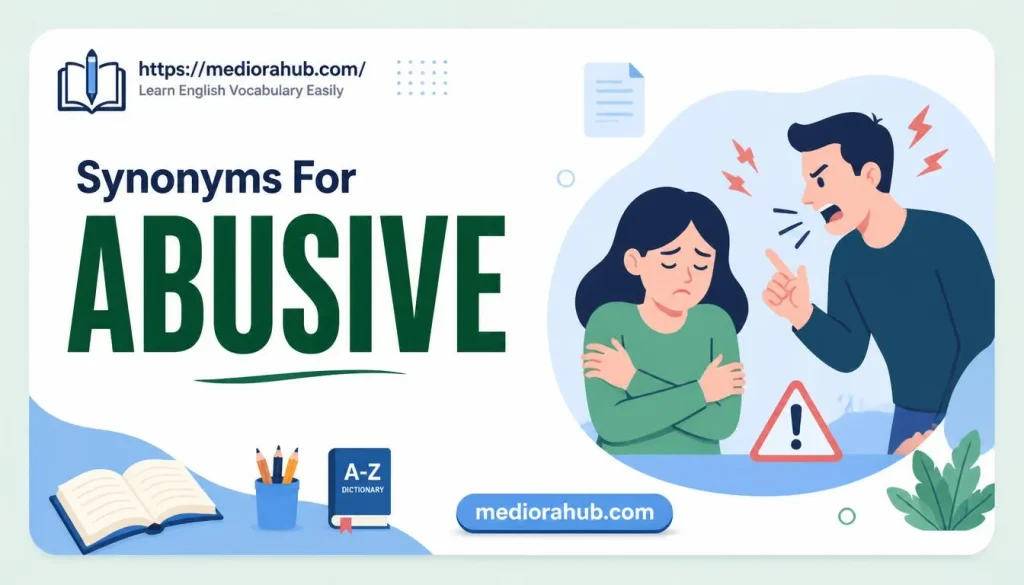

Have you ever seen someone use cruel words or treat another person badly? In such a case, you may describe that behavior as abusive. For example, a person who often insults, threatens, or hurts someone may show abusive behavior.
The word abusive usually means using harmful, cruel, or insulting behavior toward another person. It can describe words, actions, relationships, or the misuse of power. Learning synonyms for abusive can help you choose a more exact word for different situations.
Students can use these words in essays and schoolwork. Bloggers and content writers can use them to explain serious topics clearly. Daily English users can also use different words when talking about harmful behavior. In this guide, you will learn synonyms for abusive with simple meanings and examples.
Quick Answer
Common synonyms for abusive include hurtful, insulting, cruel, violent, threatening, harmful, aggressive, oppressive, controlling, harsh, and toxic.
Parts of Speech
| Word | Part of Speech | Simple Use |
| Abusive | Adjective | Describes harmful or cruel behavior |
| Hurtful | Adjective | Causing emotional pain |
| Insulting | Adjective | Showing disrespect through words |
| Cruel | Adjective | Causing pain without care |
| Violent | Adjective | Using physical force to hurt |
| Threatening | Adjective | Showing possible harm |
| Harmful | Adjective | Causing damage or pain |
| Aggressive | Adjective | Acting in an attacking way |
| Oppressive | Adjective | Treating people unfairly or harshly |
| Controlling | Adjective | Trying to control another person |
| Harsh | Adjective | Very rough or unkind |
| Toxic | Adjective | Very harmful to people or relationships |
| Hostile | Adjective | Unfriendly or angry |
| Offensive | Adjective | Causing anger or hurt |
| Mean | Adjective | Unkind or unpleasant |
| Abusive | Adjective | Treating someone in a harmful way |
| Malicious | Adjective | Intending to cause harm |
| Intimidating | Adjective | Making someone feel afraid |
| Bullying | Adjective | Involving repeated harmful treatment |
| Coercive | Adjective | Using pressure to force someone |
| Exploitative | Adjective | Using someone unfairly for benefit |
| Oppressive | Adjective | Keeping someone under unfair control |
| Domineering | Adjective | Trying to control others strongly |
| Unkind | Adjective | Not caring about another person’s feelings |
| Violating | Adjective | Breaking someone’s rights or boundaries |
| Degrading | Adjective | Making someone feel less worthy |
Hurtful
Meaning: Hurtful means causing emotional pain or sadness.
Examples:
- “His hurtful words made her cry.”
- “That was a hurtful thing to say.”
Insulting
Meaning: Insulting means using words or actions that show disrespect.
Examples:
- “His insulting comments upset the team.”
- “She stopped reading the insulting messages.”
Cruel
Meaning: Cruel means causing pain without caring about others.
Examples:
- “The cruel joke made everyone uncomfortable.”
- “It was cruel to laugh at him.”
Violent
Meaning: Violent means using physical force to hurt someone or something.
Examples:
- “The argument became violent.”
- “The police stopped the violent attack.”
Threatening
Meaning: Threatening means making someone feel that harm may happen.
Examples:
- “He sent a threatening message.”
- “Her threatening words scared the child.”
Harmful
Meaning: Harmful means causing damage, pain, or trouble.
Examples:
- “Harmful words can affect a person’s confidence.”
- “That behavior can be harmful to children.”
Aggressive
Meaning: Aggressive means acting in a forceful or attacking way.
Examples:
- “His aggressive behavior caused concern.”
- “The player became aggressive during the match.”
Oppressive
Meaning: Oppressive means treating people in a harsh and unfair way.
Examples:
- “The workers lived under oppressive rules.”
- “The group spoke against the oppressive system.”
Controlling
Meaning: Controlling means trying to decide what another person can do.
Examples:
- “His controlling behavior caused problems.”
- “She disliked his controlling attitude.”
Harsh
Meaning: Harsh means very unkind, rough, or severe.
Examples:
- “Her harsh words hurt him.”
- “The teacher used a harsh tone.”
Toxic
Meaning: Toxic means very harmful to a person or relationship.
Examples:
- “They decided to leave the toxic relationship.”
- “A toxic workplace can cause stress.”
Hostile
Meaning: Hostile means unfriendly, angry, or ready to fight.
Examples:
- “He gave me a hostile look.”
- “The meeting became hostile quickly.”
Offensive
Meaning: Offensive means causing anger, insult, or hurt.
Examples:
- “The comment was offensive to many people.”
- “He apologized for his offensive joke.”
Mean
Meaning: Mean means unkind or hurtful toward someone.
Examples:
- “Why are you being mean to your brother?”
- “Her mean comments upset her friend.”
Malicious
Meaning: Malicious means intending to hurt or harm someone.
Examples:
- “The website contained malicious comments.”
- “He made a malicious claim about his coworker.”
Intimidating
Meaning: Intimidating means making someone feel afraid or nervous.
Examples:
- “His intimidating behavior made people uncomfortable.”
- “The large man looked intimidating.”
Bullying
Meaning: Bullying means repeatedly hurting or frightening someone who may be less powerful.
Examples:
- “The school has rules against bullying.”
- “Bullying can make students feel unsafe.”
Coercive
Meaning: Coercive means using pressure or threats to make someone do something.
Examples:
- “The group used coercive tactics.”
- “She rejected the coercive demand.”
Exploitative
Meaning: Exploitative means using someone unfairly for your own benefit.
Examples:
- “The company was accused of exploitative practices.”
- “Workers spoke about the exploitative conditions.”
Domineering
Meaning: Domineering means trying to control people in a strong and unfair way.
Examples:
- “His domineering attitude upset his coworkers.”
- “She did not like her manager’s domineering style.”
Unkind
Meaning: Unkind means not caring about another person’s feelings.
Examples:
- “That was an unkind comment.”
- “He apologized for being unkind.”
Violating
Meaning: Violating means breaking someone’s rights, privacy, or personal limits.
Examples:
- “Sharing her photo felt violating.”
- “The action was seen as violating his privacy.”
Degrading
Meaning: Degrading means making someone feel ashamed or less worthy.
Examples:
- “The degrading remarks hurt her deeply.”
- “No worker should face degrading treatment.”
Abusive
Meaning: Abusive means treating someone in a harmful, cruel, or insulting way.
Examples:
- “She left an abusive relationship.”
- “The teacher reported the abusive behavior.”
Frequently Asked Questions
1. What is the simplest synonym for abusive?
Hurtful or unkind can be simple alternatives when talking about behavior that causes emotional pain.
2. What are common synonyms for abusive?
Common alternatives include cruel, hurtful, insulting, harmful, aggressive, threatening, hostile, and controlling.
3. Is “toxic” a synonym for abusive?
Sometimes. Toxic describes something very harmful, especially a relationship or environment. It does not always mean abusive.
4. Is “violent” the same as abusive?
Not always. Violent usually refers to physical force or physical harm, while abusive can include emotional, verbal, physical, or other harmful behavior.
5. What is a formal synonym for abusive?
Depending on the context, oppressive, coercive, exploitative, malicious, or harmful may work in formal writing.
6. What is the opposite of abusive?
Possible opposites include kind, respectful, caring, supportive, gentle, and protective.
7. Can abusive describe words?
Yes. For example, abusive language can refer to insulting, threatening, or harmful language.
8. Can abusive describe a relationship?
Yes. An abusive relationship is a relationship in which one person harms, controls, threatens, or mistreats another person.
9. Why should I learn synonyms for abusive?
Learning related words helps you describe harmful behavior more clearly and choose the right word for each situation.
Conclusion
Learning synonyms for abusive gives you more ways to describe harmful or unkind behavior. Words such as hurtful, cruel, insulting, threatening, controlling, and harmful can make your writing more precise. These words are useful in writing, blogging, speaking, and daily communication. Practice them in emails, essays, articles, and conversations. The more you use new vocabulary, the easier it becomes to choose the right word.